TL;DR (6-minute read): A lease extension keeps you in your car temporarily on a month-to-month or short-term basis, while a lease buyout lets you own it outright, often for less per month than starting a new lease.
Table of Contents
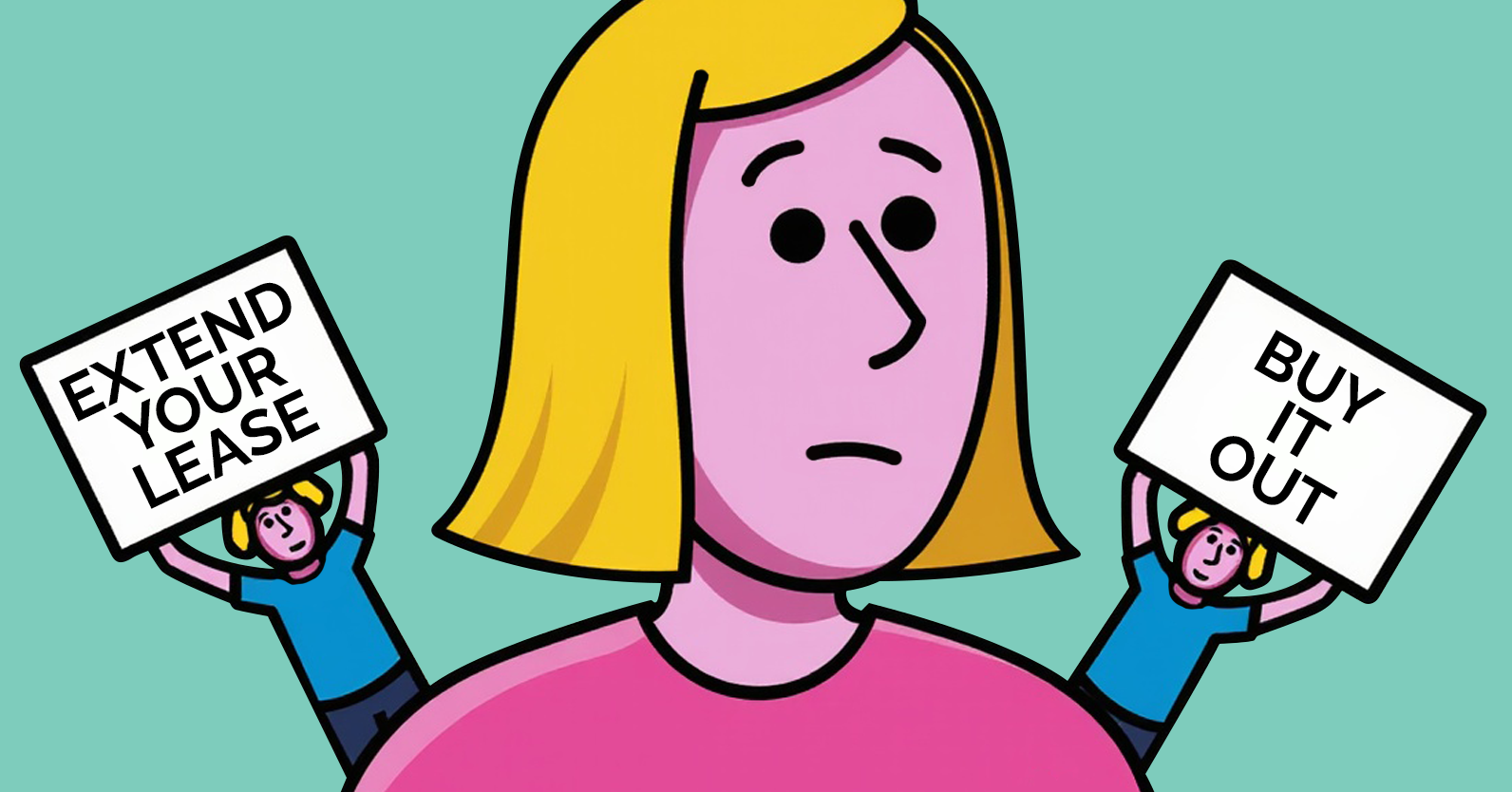
Your lease end date is coming up. You like your car. You don't necessarily want to go through the whole song and dance of shopping for something new. And now someone's telling you that you have options, a lease extension or a buyout, and you're not quite sure which one makes sense for your situation.
Both choices let you keep driving your current car. That's where the similarities end. One is a temporary solution; the other is a permanent one. One keeps you paying the leasing company indefinitely; the other builds toward ownership.
Let's break down exactly how lease extensions and buyouts work, when each one makes sense, and why, for a lot of drivers, a buyout through Lease End ends up being the better move — financially and otherwise.
What Is a Lease Extension?
TopA lease extension is an agreement with your leasing company to continue your existing lease beyond its original end date, usually month-to-month or for a short defined period (typically 1 to 6 months).
Extensions are not automatic. You have to request one from your leasing company, and not all of them offer them on the same terms. Some are month-to-month at your same payment; others require a new short-term contract.
What stays the same during an extension:
- Your monthly payment (usually the same as before)
- Your mileage cap, you're still subject to overage fees if you go over your allowed limit
- Wear-and-tear standards, the vehicle still needs to meet the leasing company's condition requirements at turn-in
- The fact that you don't own the car
An extension is essentially buying time. It's useful if you need a few extra weeks or months while you figure out your next step. But it doesn't solve anything long-term, and it doesn't build any equity.
What Is a Lease Buyout?
TopA lease buyout is exactly what it sounds like: you purchase your leased vehicle from the leasing company, typically at a price that was fixed in your original lease contract, the
residual value.
Most lessees do a financed buyout: they take out a lease buyout loan to cover the residual value (plus taxes and applicable fees), and then make monthly payments on that loan, just like any other car payment. At the end of the loan term, the car is yours, free and clear.
Here's what changes when you buy out:
- No more mileage restrictions
- No more wear-and-tear inspections
- No disposition fee at turn-in
- You start building equity in an asset you actually own
- Your monthly payment is often lower than leasing a new car would be
For a deeper explainer, check out
What Is a Lease Buyout. But the short version: it's the difference between renting and owning.
Lease Extension vs. Buyout: The Core Differences
TopHere's a side-by-side look at how the two options stack up:
| Lease Extension | Lease Buyout |
| Duration | 1-6 months (temporary) | Permanent, you own the car |
| Monthly payment | Same as your current lease | New loan payment (often lower than a new lease) |
| Mileage limits | Still applies | Gone. Drive as much as you want. |
| Wear-and-tear fees | Still applies at turn-in | Gone. It's your car. |
| Disposition fee | You'll pay it eventually | Waived (you're buying, not returning) |
| Equity | None, you're still renting | Yes, you're building equity with each payment |
| Best for... | Buying time while deciding | Drivers who want to keep the car long-term |
When a Lease Extension Makes Sense
TopA lease extension isn't the right long-term answer for most drivers, but it's genuinely useful in a handful of situations:
You need more time to decide
If you're on the fence about whether to buy out, purchase something new, or start a fresh lease, a short extension buys you that breathing room without forcing a rushed decision.
You're waiting on a specific new vehicle
Ordered a new car that's delayed? An extension can bridge the gap between your lease end date and the delivery date, so you're not without transportation.
Something big is about to change in your life
Job relocation, major life event, credit situation in flux, if your circumstances are genuinely in transition and you need 60 days of stability, an extension can make sense.
The key thing to remember: an extension is a bridge, not a destination. If you're extending month after month, you're just paying lease prices indefinitely while building zero equity. At some point, the
buyout conversation is worth having.
When a Lease Buyout Makes More Sense
TopNot sure where you land on all five of these? Run your car through the Lease End Buyout Score. It weighs your equity, how reliable the car has been, what it would cost to replace, how in-demand it is, and your mileage — five factors, not one. 👉
Lease Buyout ScoreFor most drivers who like their current car and want to keep it, a buyout is the better move. Here's when it's especially compelling:
You like the car and know its history
You've driven this car for two or three years. You know exactly how it's been maintained, what quirks it has (if any), and whether it's been reliable. Buying a known quantity beats taking a gamble on a new car or an unknown used vehicle from a lot.
Your car has positive equity
If your car's current market value is higher than the residual value in your lease, congratulations, you have
positive equity. That equity is yours to capture if you buy the car. If you turn it in instead, the leasing company keeps it. That's a real dollar difference you're leaving on the table.
You want out of the lease cycle
Leasing forever means you're always making car payments, always bound by mileage restrictions, and never building equity. A buyout breaks that cycle. Your loan ends; the car is yours.
And once it's yours, you decide what happens next. Keep it for another five years, or sell it whenever the timing suits you. That's not a decision you have to make now — it's one you get to make later, on your own schedule.
You've gone over on mileage
If you're over your
mileage limit, turning in the car means paying overage fees, often $0.15 to $0.30 per mile. Those can add up to hundreds or thousands of dollars. A buyout sidesteps that entirely: no mileage penalties, ever.
The car has wear-and-tear issues
Minor dings, a repaired bumper, interior wear, the kind of stuff that happens when you actually drive a car. Turn it in, and you may face excessive-wear fees. Buy it out, and you skip the inspection entirely.
The Numbers: What a Buyout Actually Costs vs. Extending
TopLet's make this concrete. Here's a simplified comparison to show how the math can play out.
Scenario: Driver with a 2022 midsize sedan, lease ending
| Lease Extension (6 months) | Buyout via Lease End |
| Monthly payment | $550/mo (same as current lease) | ~$490/mo (based on credit, terms) |
| Mileage overage fees at turn-in | ~$600 (2,000 miles over at $0.30/mi) | $0 |
| Disposition fee | ~$400 (paid at turn-in) | $0 (waived on buyout) |
| Total 6-month cost | $4,300 | $2,940 (+ you own the car) |
| Equity after 6 months | $0 | Yes, vehicle is yours, equity building |
Note: Monthly payment estimates are illustrative. Your actual buyout payment depends on your residual value, credit score, loan term, and lender. Use the
Lease End Buyout Calculator to get real numbers based on your specific vehicle.
For broader rate context: as of September 2026, Lease End drivers with excellent credit (800+) are averaging 6.26% APR on lease buyout loans.
The average monthly buyout payment across all credit profiles is $580.36, compared to the $619/month national average for a new lease payment, according to Experian. That's about $40/month you're keeping in your pocket, and you're building equity instead of handing it back at the end of a new term.
How Lease End Makes a Buyout Easy
TopIf a buyout is sounding like the right move, here's the part where we make the case for doing it through us, and we promise to keep it brief.
Lease End is a free service that handles your lease buyout entirely online. No dealership visit. No doc fees. No hold music. (Okay, maybe some hold music if you call us, but we promise it's not from 2008.)
Here's how it works:
- Tell us about your car. Enter your VIN or license plate. We pull up your lease details and get the process started.
- View your loan and coverage options. We shop our network of trusted lenders, including Ally, TD Bank, and Capital One, to find you the most competitive rate based on your credit profile.
- Sign your documents. Everything is eSigned securely through your Lease End account. No printing, no faxing, no notary trips.
- We handle the rest. Title transfer, vehicle registration, new plates, we coordinate all of it. You don't go to the DMV.
And because we facilitate a high volume of lease buyouts, we get preferred rates from our lending partners, rates you'd have a hard time finding on your own.
Want to see how Lease End compares to going through a dealership? Check out
Is Lease End Legit? for the full breakdown.
Final Thoughts
TopA lease extension is a perfectly reasonable tool when you genuinely need time. But it's a pause button, not a plan. If you like your car, the math almost always favors a buyout, lower monthly payments than a new lease, no mileage caps, no wear-and-tear inspections, and equity that actually belongs to you.
The good news: figuring out which path makes sense for your situation doesn't have to be complicated. Lease End can pull your numbers, walk you through your options, and if a buyout is right for you, handle the whole thing online, from couch to ownership.
Start with your VIN or license plate in the form below or call
(844) 902-2842 to talk through your options with a buyout advisor. No obligation, no pressure, just straight answers. Check your
vehicle's lease buyout score.
Frequently Asked Questions
TopCan I extend my lease and then do a buyout later?
In most cases, yes, but it depends on your leasing company's policies. Some allow buyouts during an extension period; others require you to decide before extending. Check with your leasing company before assuming that door stays open. If you're thinking about buying out, it's worth starting that process sooner rather than later.
Does a lease extension affect my credit?
A lease extension itself typically doesn't trigger a new credit inquiry, it's just a continuation of your existing contract. A buyout, on the other hand, involves applying for a new loan, which does include a credit check. The good news: when Lease End shops your deal across multiple lenders, multiple inquiries within a 14-day window count as just one inquiry on your credit report (per Experian guidelines).
What if my car is worth less than the residual value?
If your car's market value has dropped below the residual value, known as negative equity, you'd be paying more than the car is worth on paper. Returning it is a fair option, and plenty of drivers take it. Just price out the turn-in first: excess mileage runs $0.15 to $0.30 per mile, and disposition and wear-and-tear charges sit on top of that. If those come to more than the gap, buying out is the cheaper exit — and if you like this car, know how it's been treated, and don't want to spend a weekend shopping for a replacement, none of that shows up in the residual value either.
How long can I extend my lease?
Extension terms vary by leasing company. Some allow month-to-month indefinitely; others cap extensions at 3 or 6 months. A few won't extend at all. Contact your leasing company directly to find out what your options are, and then use that information to decide whether an extension is the right bridge or whether a buyout is the smarter long-term play.
Is there a fee for extending my lease?
Usually not a separate extension fee, you just keep paying your existing monthly payment. But remember: you're still subject to all the same end-of-lease fees (mileage overages, wear-and-tear, disposition) when you eventually do return the car. Extensions delay those fees; they don't eliminate them.
Can I do a lease buyout if I have bad credit?
Yes, in many cases. Lease End works with lenders who serve a wide range of credit profiles, including scores as low as 520. Your rate will be higher with lower credit, but a buyout is often still an option.