TL;DR (6-minute read): A disposition fee is a charge your leasing company applies when you return your car at the end of a lease, typically ranging from $300 to $595, depending on your brand. The easiest way to avoid it entirely? Buy out your lease through Lease End, skip the dealership, and keep the car you already love.
Across 19,287 buyouts in 2025, Lease End customers captured $73,155,589 in total savings, an average of roughly $3,800 in avoided overage fees plus about $5,500 in equity per driver. The disposition fee is only one of several end-of-lease charges a buyout erases.
When your lease is wrapping up, you're probably focused on the big decisions: keep the car, get a new one, or hand over the keys and walk away. What you might not be thinking about? The $300 to $500 charge that quietly appears on your final statement when you do that last option.
That's the disposition fee. It's one of the more frustrating end-of-lease surprises, not because it's huge, but because it's easy to miss until it's too late.
This guide breaks down what disposition fees actually are, how much each major car brand typically charges, and the one move that makes the whole thing irrelevant.
Table of Contents
What Is a Disposition Fee?
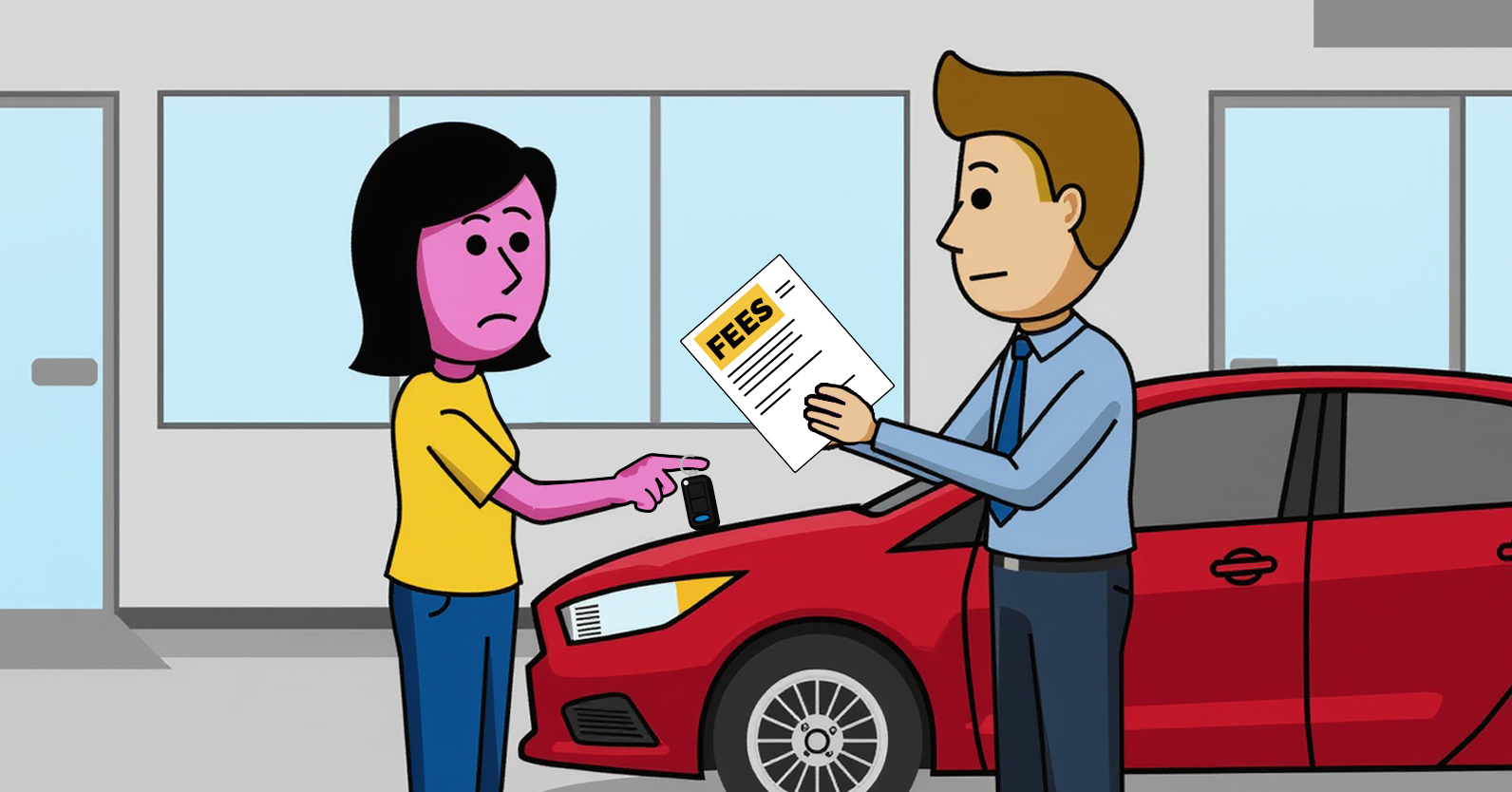
TopA disposition fee, sometimes called a "turn-in fee" or "termination fee", is a charge your leasing company applies when you return your leased vehicle at the end of the lease term without purchasing it or re-leasing another vehicle.
Think of it as the leasing company's cost of doing business with a returned car: inspecting it, reconditioning it, and getting it back to the lot for resale. You're essentially paying for the hassle of them taking it back.
The fee is typically listed in your original
lease agreement, buried in the fine print, of course, so it's technically not hidden. But "technically disclosed" and "something you knew about" aren't always the same thing.
Typical range: $300 to $595, depending on the brand and your specific lease terms.
The disposition fee rarely shows up alone. In Lease End's own state data, a typical Maine driver faces roughly $1,000 in mileage overage plus a $350 disposition fee, about $1,350 in return costs, against $310 in positive equity from buying out, a net swing of $1,600 or more in favor of keeping the car. The disposition fee is the small part of a much larger bill.
Disposition Fee by Car Brand (2026 Table)
TopHere's what you can expect to pay by brand when returning your leased vehicle in 2026. Keep in mind these are typical ranges; your exact amount will be in your lease contract.
| Car Brand | Disposition Fee Range | Typical Amount | Notes |
| BMW | $300 – $400 | $350 | Waived if you re-lease or purchase a BMW |
| Honda / Acura | $300 – $400 | $300 | Standard at lease end; no waiver common |
| Ford | $300 – $400 | $350 | May be waived with loyalty program |
| Chevrolet / GM | $300 – $500 | $395 | Varies by GM Financial agreement |
| Toyota / Lexus | $300 – $400 | $350 | Toyota Financial Services; consistent across models |
| Honda Financial | $300 – $400 | $300 | Applied to returned vehicles |
| Hyundai / Kia | $400 | $400 | Flat fee; Hyundai Motor Finance |
| Nissan / Infiniti | $300 – $400 | $350 | NMAC; waived with new Nissan lease |
| Volkswagen / Audi | $350 – $500 | $395 | VW Credit / Audi Financial |
| Mercedes-Benz | $350 – $595 | $595 | Higher end; premium brand premium fee |
| Subaru | $300 | $300 | Among the lowest standard fees |
| Jeep / RAM / Stellantis | $300 – $400 | $350 | Chrysler Capital; varies by model |
| Tesla | N/A | $0 (currently) | Tesla handles buyouts differently; no standard disp. fee |
*Fees are subject to change and vary by lease agreement. Always confirm your exact amount in your lease contract or by calling your leasing company.
Worth pairing the fee with what your car is actually worth. Across the most popular 2025 buyouts, every one of the top 10 models carried positive average equity, ranging from $2,397 on the Jeep Wrangler to $7,886 on the Honda CR-V. For most of these brands, the equity you'd forfeit by returning the car dwarfs the disposition fee itself:
| Brand / Model | Disposition Fee (typical) | Avg. Equity at Buyout (2025) |
| Honda CR-V | $300 | $7,886 |
| Honda Accord | $300 | $7,886 |
| Honda Civic | $300 | $6,735 |
| Toyota Tacoma | $350 | $6,601 |
| Mazda CX-5 | n/a (Chrysler/other) | $6,214 |
| Honda Pilot | $300 | $5,543 |
| Ram 1500 | $350 | $5,476 |
| Honda HR-V | $300 | $5,358 |
| Jeep Grand Cherokee | $350 | $2,883 |
| Jeep Wrangler | $350 | $2,397 |
Why Do Leasing Companies Charge a Disposition Fee?
TopLeasing companies make money in several ways, and one of them is recovering costs associated with returned vehicles. When you hand back the keys, the car needs to be:
- Inspected for excess wear and damage
- Cleaned, reconditioned, and potentially repaired
- Transported to an auction or dealership lot
- Remarketed and resold
That's real money, and the disposition fee is their way of passing some of that cost to you.
There's also a retention incentive baked into this fee structure. Leasing companies would rather you re-lease or buy another car from them than return the vehicle. So the fee also functions as a gentle nudge: "Stay with us and we'll waive this. Leave, and you're paying."
Many brands (BMW, Toyota, Nissan, and others) will waive the disposition fee if you
lease or purchase another vehicle through them. That's worth knowing before you just hand back the keys.
Note the catch in that retention waiver: it only saves you the fee if you start another lease, restarting depreciation, fees, and mileage limits all over again. Buying out the car you already have avoids the disposition fee without committing you to a fresh lease cycle. In 2025 the average lease buyout payment ran about $563 a month versus roughly $659 for a new lease on a comparable vehicle, around $1,200 a year in savings before the disposition fee is even counted.
How to Avoid the Disposition Fee
TopYou've got a few options if you'd rather not pay the disposition fee:
1. Re-Lease or Purchase Through the Same Brand
Many leasing companies will waive the fee if you stay loyal. Check with your leasing company, if you're planning to get another car from the same brand, ask explicitly about disposition fee waiver as a loyalty benefit.
2. Buy Out Your Lease
The cleanest way to avoid a disposition fee is to buy out your lease instead of returning the car. When you purchase your leased vehicle, whether through a dealership or through Lease End, the disposition fee disappears entirely. You're keeping the car, so there's nothing to "dispose of."
Buying out also wipes out a second charge most drivers forget: mileage overage. The average Lease End customer hit 36,954 miles at lease-end in 2025, about 954 over the standard 36,000-mile cap, and overage runs 10 to 30 cents a mile. High-mileage models make the case even sharper: Jeep Wrangler lessees averaged 44,740 miles, roughly 8,740 over the cap, translating to about $2,622 in overage fees avoided by buying out. Stack that on top of a $300 to $595 disposition fee and the return-the-car math gets expensive fast.
3. Negotiate It Away
In some cases, you can negotiate the fee if you have a strong relationship with the dealer or are making a new purchase. It doesn't always work, but it's worth asking.
4. Transfer the Lease
Some leases allow you to transfer your lease to another driver before the term ends. Depending on your agreement, this could reduce or eliminate
end-of-lease fees, including disposition. Check your lease contract for transfer terms.
What Happens If You Buy Out Your Lease Instead?
TopHere's the thing: if you like your car (and let's be honest, you probably do, you've been driving it for three years), buying it out is often a genuinely great financial move. You avoid the disposition fee, dodge mileage overage charges, keep any
equity you've built, and skip the whole "start a new lease from scratch" dance.
The main thing you'll need is a lease buyout loan. That's just an auto loan that pays off the leasing company's buyout price (called the residual value), and then you make monthly payments on your car like any other owned vehicle.
And here's where Lease End comes in.
Lease End: Skip the Disposition Fee and the Dealership
Lease End is a free, fully online platform that helps you buy out your lease without setting foot in a dealership. No doc fees. No pressure. No hold music.
Lease End has now completed more than 50,000 lease buyouts since 2021, and in 2025 alone facilitated $590 million in vehicle loans while unlocking $108 million in equity for drivers. That transaction volume is what powers every average in this guide.
Here's how it works:
- Tell us about your lease. Enter your VIN or license plate and we'll pull up your details.
- We shop your deal to our lending network. Our banking partners, including Ally Financial, Capital One, TD Bank, and others, compete for your business so you get the best available rate.
- You eSign your documents. Fully online, from your couch. No printer required.
- We handle the title, registration, and plates. You don't have to go near a DMV.
As of May 2026, Lease End drivers with excellent credit (800+) averaged a 6.17% APR on lease buyout loans. Across all credit profiles, the average APR was 9.05%. Here's the full picture:
| Credit Score | Average APR |
| >800 | 6.17% |
| 740-799 | 6.59% |
| 670-739 | 8.10% |
| 580-669 | 11.25% |
| <580 | 15.61% |
APR averages based on Lease End lease buyout transactions through May 2026. Rates vary based on credit score, loan amount, term, and lender eligibility.
Where you live matters too. Lease End's 2026 data shows average buyout APRs spanning from a low of 7.96% in
Idaho to a high of 11.29% in
Oklahoma, a gap that adds up to more than $3,000 in extra interest on a $30,000, 72-month loan. The national average sits at 9.34%, with the Midwest running the most favorable rates and the Southeast about 37 basis points higher.
Bottom line: if you're staring down a $350 disposition fee and you actually like your car, it's worth spending two minutes with our
Lease Buyout Calculator to see what your monthly payment would look like. The math often surprises people, in a good way.
Final Thoughts
TopThe disposition fee isn't the biggest number you'll encounter at the end of a lease, but it's one of the easiest to avoid. If you're planning to return your car and walk away, at least know what's coming and build it into your budget.
But if there's even a small part of you that likes your current car, it's genuinely worth running the numbers on a buyout. Avoiding the disposition fee is just the beginning. You'd also skip mileage overage penalties, keep any equity built into the vehicle, and own a car you already know inside and out.
Lease End exists to make that buyout process painless. Fill out the form with your license plate or VIN, and we'll show you your numbers, no commitment required.
Ready to skip the disposition fee and keep your car? Start with your VIN or license plate in the form at the bottom of this page, or call us at
(844) 902-2842.
Frequently Asked Questions
TopWhat is a disposition fee on a car lease?
A disposition fee is a charge your leasing company applies when you return your vehicle at the end of the lease without buying it or leasing another car through them. It typically ranges from $300 to $595 and covers the cost of reconditioning and remarketing the returned vehicle.
Is the disposition fee negotiable?
Sometimes, but not always. Many leasing companies will waive it as a loyalty incentive if you lease or purchase another vehicle through the same brand. If you're planning to return your car without making another purchase, your negotiating leverage is limited.
Do I pay a disposition fee if I buy out my lease?
No. Disposition fees only apply when you return the vehicle. If you buy out your lease, whether through a dealership or through Lease End, the fee is eliminated entirely. This is one of the less-celebrated perks of a lease buyout.
Which car brands have the highest disposition fees?
Mercedes-Benz typically charges the highest disposition fee, around $595. Volkswagen, Audi, and some GM vehicles can also run $395 to $500. On the lower end, Subaru and Honda tend to cap around $300.
Can I avoid the disposition fee if I lease a different brand?
Generally, no. Loyalty waivers are brand-specific. If you're returning a Toyota and leasing a Honda next, Toyota Financial Services isn't going to waive their fee because you got a new car, just not one of theirs.
When is the disposition fee charged?
The disposition fee is typically charged at or shortly after the official lease return. Some leasing companies bill it in your final statement; others invoice separately after the vehicle inspection is complete.
Does Lease End charge any fees?
No. Lease End is free to use. No doc fees, no markups, no hidden add-ons. We earn money through our lending partnerships, similar to how a loan officer earns a commission, which means our incentives are aligned with getting you the best rate, not nickel-and-diming you at the end.
Is buying out my lease worth it just to avoid a $350 fee?
Often the disposition fee is the smallest reason to buy out. In 2025, Lease End customers averaged roughly $5,500 in equity plus about $3,800 in avoided overage fees per driver, and a typical buyout payment of about $563 a month ran roughly $100 a month less than a new lease on a comparable car. The disposition fee is real money, but it usually sits alongside far larger savings once you run your specific numbers.